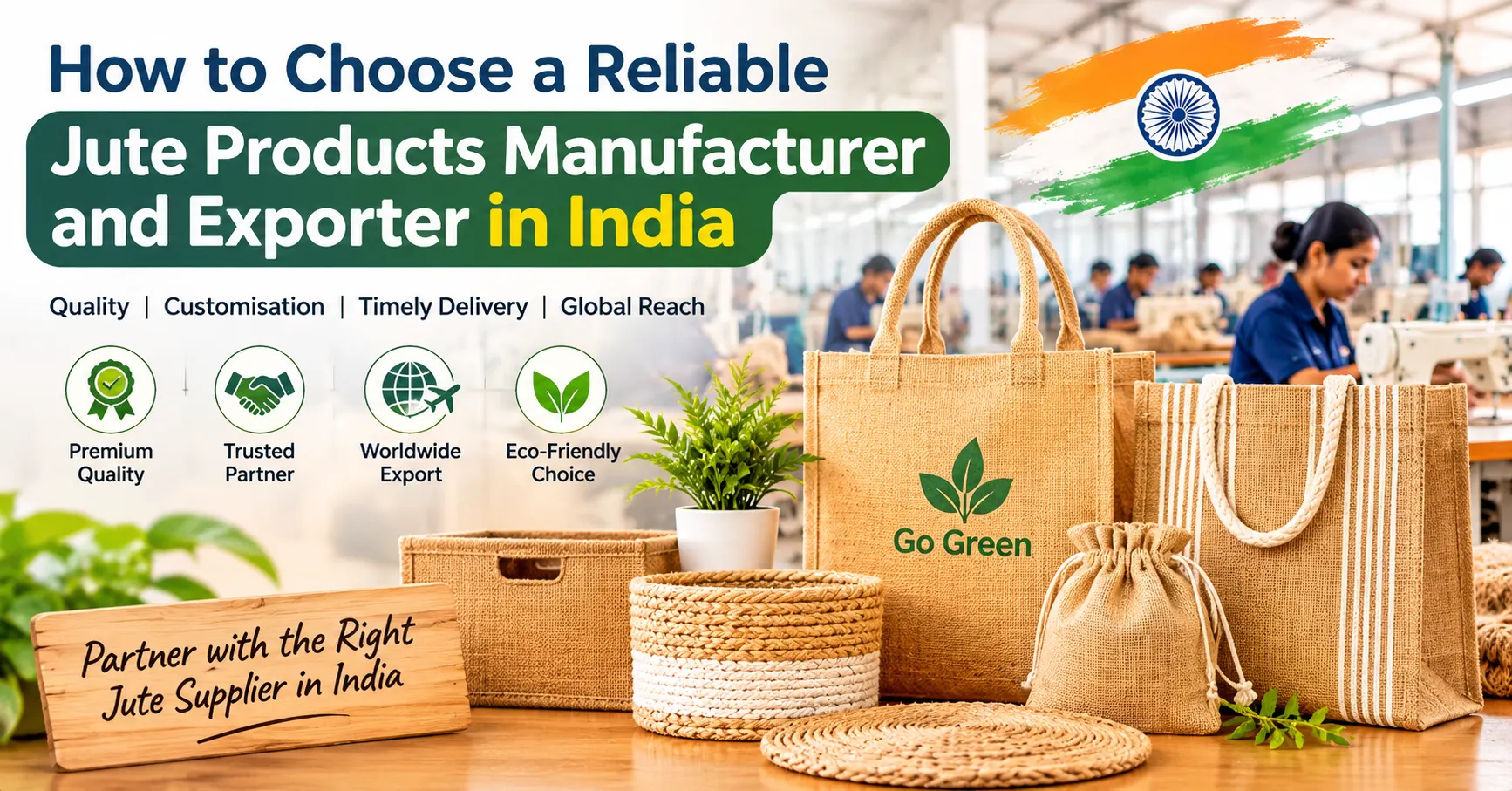
How to Choose a Reliable Jute Products Manufacturer and Exporter in India
Jute products are finding their place in modern homes, retail stores, packaging businesses and lifestyle collections. From reusable shopping bags and storage baskets to table accessories, rugs and decorative items, jute offers businesses an attractive material for developing practical and nature-inspired products.
For importers, wholesalers, retailers and private-label brands, India is an important sourcing destination for jute products. However, choosing the right supplier takes more than comparing prices. Product quality, manufacturing capabilities, material consistency, communication and export arrangements all play an important role in a successful business relationship.
If you are searching for a jute products manufacturer India or planning to work with a jute products exporter India, it is worth taking time to evaluate your options before placing a bulk order.
This guide explains what to look for, which questions to ask and how to make a more informed sourcing decision.
1. Understand Your Product Requirements First
Before approaching manufacturers, be clear about the products you want to source. Jute is used in many applications, and each product can have different requirements for construction, finishing, dimensions and packaging.
For example, a retailer looking for reusable shopping bags may have different expectations from a home décor brand sourcing jute baskets or table accessories.
Prepare a basic product requirement document covering:
-
Product type and intended use.
-
Required dimensions, shape and design.
-
Jute material specifications and any blended materials.
-
Colour, printing, embroidery or other customisation.
-
Stitching, handles, lining and finishing details.
-
Branding, labels and packaging requirements.
-
Estimated order quantity and delivery destination.
If you have reference photographs, product samples or technical drawings, share them with potential suppliers. Clear requirements help manufacturers understand your expectations and provide more accurate quotations.
2. Check the Manufacturer's Product Range and Experience
A reliable supplier should be able to explain the products they manufacture or source and show examples of relevant work.
Start by reviewing the company's website, product catalogue and available product photographs. Look for details that demonstrate its understanding of jute products, rather than relying only on general business descriptions.
Depending on your requirements, you may want to explore:
-
Jute shopping and promotional bags.
-
Jute tote bags and carry bags.
-
Jute storage baskets and organisers.
-
Jute table runners and placemats.
-
Jute home furnishing accessories.
-
Decorative and lifestyle products.
-
Custom-designed jute products for private labels.
Ask whether the company handles manufacturing directly, works with production partners or operates as an exporter sourcing from other units. These business models can all serve buyers, but it is important to understand who is responsible for production, quality checks and delivery.
An experienced jute products manufacturer India should be comfortable discussing product construction, customisation possibilities and the practical requirements of your order.
3. Evaluate Material Quality and Product Finishing
The quality of a jute product depends on more than its appearance in a catalogue photograph. Material selection, weaving, stitching and finishing all influence the final result.
Before confirming a bulk order, ask the supplier to explain the material specifications and provide a sample wherever possible.
Pay attention to the following details:
- Material consistency: Check whether the material matches the agreed specifications in terms of texture, thickness, colour and overall appearance.
- Weaving and construction: Look for consistent weaving, suitable fabric construction and a finish appropriate for the intended use.
- Stitching quality: Examine seams, handles, corners and joining areas. Poor stitching can affect the appearance and usability of a product.
- Finishing: Check for loose threads, uneven edges, stains, unwanted odours and inconsistent finishing.
- Product dimensions: Confirm measurements and acceptable tolerances before production.
- Accessories and components: If the product includes zippers, buttons, handles, linings or other accessories, make sure their specifications are clearly agreed upon.
A physical sample is one of the most useful ways to evaluate a supplier. It gives you an opportunity to review the actual product instead of making a decision based entirely on photographs.
4. Ask About Customisation and Private Label Manufacturing
Many international buyers want products that match their own brand identity. Standard catalogue designs may not be enough, especially for retailers, wholesalers and lifestyle brands developing exclusive collections.
Before selecting a manufacturer, ask about its customisation capabilities.
Depending on the product and production setup, customisation may include:
-
Custom sizes, shapes and designs.
-
Brand logos and printed artwork.
-
Custom colours and material combinations.
-
Labels, tags and branding details.
-
Product-specific stitching and finishing.
-
Custom packaging and presentation.
-
Private-label product development.
Ask how the supplier handles artwork, samples and design approvals. It is also important to confirm which customisation requests are technically and commercially practical.
A professional supplier will discuss limitations honestly instead of promising that every design can be produced without reviewing its specifications.
5. Verify Export Capability and Business Details
If you are buying from outside India, choosing an export-ready supplier is particularly important.
A company may offer attractive products, but that does not automatically mean it has the documentation, experience or arrangements needed to handle international shipments.
Before proceeding, ask for the supplier's legal business details and relevant export information.
You can review:
-
Registered business name and address.
-
GST registration details, where applicable.
-
Importer-Exporter Code (IEC), where applicable.
-
Commercial invoice and packing list arrangements.
-
Shipping methods and destination coverage.
-
Experience with international buyers.
-
Availability of product-specific documentation, where required.
The Importer-Exporter Code is an important business identification requirement for exports from India, subject to applicable exemptions. Buyers can ask for the supplier's IEC details and verify them through the Directorate General of Foreign Trade (DGFT).
Do not rely only on a certificate or registration number shared in a message. Check whether the details match the business name and other documents provided by the supplier.
You can refer to the official DGFT website for IEC-related information.
6. Compare Quotations Carefully, Not Just the Final Price
Price is an important part of sourcing, but the lowest quotation does not always represent the best value.
Two suppliers may quote different prices for products that appear similar but use different materials, construction methods, accessories or packaging.
When comparing quotations, check whether they cover the same specifications.
Your comparison should include:
-
Product dimensions and material details.
-
Manufacturing and finishing requirements.
-
Customisation and branding charges.
-
Sample development costs.
-
Packaging specifications.
-
Minimum order quantity (MOQ).
-
Production lead time.
-
Shipping and freight charges.
-
Payment terms and applicable taxes or duties.
For international orders, also clarify the agreed delivery terms and which party is responsible for freight, insurance, customs clearance and other charges.
Request a written quotation with a clear product description. This reduces misunderstandings and makes it easier to compare suppliers on an equal basis.
7. Understand MOQ, Sampling and Production Timelines
Minimum order quantity can vary depending on the product, design, material availability and level of customisation.
Some manufacturers may accept smaller quantities for standard products, while customised designs may require higher order volumes.
Before placing an order, ask:
-
What is the MOQ for standard products?
-
Does a custom design have a different MOQ?
-
Can different colours or designs be combined in one order?
-
Is sample development available?
-
How much time is required for sampling?
-
What is the estimated bulk production timeline?
-
When does the production schedule begin?
Do not treat a verbal delivery estimate as a confirmed commitment. Ask the supplier to provide an expected production schedule in writing.
For new suppliers, approving a sample before bulk production is a sensible step. It allows both parties to agree on the product's appearance, measurements, materials and finishing.
8. Review Quality Control and Inspection Practices
Quality should be checked throughout the order process, not only when the shipment is ready.
A dependable manufacturer or exporter should be able to explain how product specifications are communicated to the production team and how finished goods are checked.
Discuss quality control at different stages:
- Before production: Confirm the approved sample, material specifications, measurements and artwork.
- During production: Ask how the supplier monitors stitching, construction, dimensions and consistency.
- Before dispatch: Clarify whether finished products are inspected for defects, quantity, packaging and labelling.
If you are sourcing remotely, ask whether the supplier can share progress photographs, videos or inspection updates. For larger orders, you may also discuss an independent inspection arrangement.
Make sure the inspection criteria are agreed upon in advance. Terms such as "good quality" are too broad to avoid disputes. Specific measurements, acceptable tolerances and agreed sample standards provide a much clearer basis for checking products.
9. Check Communication and Professionalism
Good communication can make a major difference to an international sourcing relationship.
Pay attention to how the supplier responds during the initial enquiry. Do they understand your requirements? Do they ask relevant questions? Are their quotations clear? Can they explain production limitations and delivery expectations?
Look for a supplier who:
-
Responds within a reasonable time.
-
Provides clear product information.
-
Shares quotations with proper specifications.
-
Explains MOQ and production schedules.
-
Communicates changes or delays honestly.
-
Provides updates during sampling and production.
-
Maintains written records of important approvals.
Be cautious if a supplier avoids answering basic questions, changes commercial terms without explanation or makes unrealistic promises.
A reliable business partner should make the sourcing process easier to understand, not more confusing.
10. Start with a Sample or Manageable Trial Order
If you are working with a new supplier, it may be better to begin with product samples or a manageable initial order rather than committing to a large quantity immediately.
A sample allows you to check material quality, construction, design accuracy and finishing. A trial order can help you understand how the supplier manages production, packaging, communication and dispatch.
Use this stage to evaluate:
-
Whether the delivered product matches the approved sample.
-
Whether the agreed specifications are followed.
-
Whether the order is completed within the confirmed timeline.
-
Whether packaging is suitable for transportation.
-
Whether the supplier communicates effectively.
-
Whether any issues are handled professionally.
Once you are satisfied with the supplier's performance, you can discuss repeat orders and larger production requirements with greater confidence.
Common Mistakes to Avoid When Choosing a Jute Supplier
Even experienced buyers can face problems when sourcing products without checking the details carefully.
Here are some common mistakes worth avoiding:
- Choosing only on price: A low quotation may not include the same material, construction or packaging specifications as another supplier's offer.
- Skipping sample approval: Photographs cannot always show the actual texture, stitching and finishing of a product.
- Ignoring export arrangements: Confirm who will handle the export documentation, shipment and related responsibilities.
- Leaving specifications unclear: Verbal discussions can lead to different expectations about dimensions, colours, materials and branding.
- Overlooking quality checks: Agree on inspection standards before production starts.
- Placing a large first order without evaluation: A sample or trial order can help you assess the supplier before making a bigger commitment.
Taking these precautions can reduce avoidable misunderstandings and support a more dependable sourcing process.
Why Consider an Indian Jute Products Manufacturer and Exporter?
India offers sourcing opportunities for businesses looking for jute-based products across bags, accessories, home furnishings and other lifestyle categories.
Working with an Indian supplier can give buyers access to product development, customisation and manufacturing or sourcing arrangements suited to different business requirements.
However, the right partner depends on your product specifications, order quantity, quality expectations, target market and delivery requirements.
Rather than choosing a supplier simply because it is based in India, focus on its ability to understand your requirements and manage the complete order process.
Partner with SKV Tradex for Jute and Lifestyle Product Enquiries
At SKV Tradex, we work across jute products, macrame, textile home furnishings and apparel. We understand that business buyers need products that meet their design expectations, commercial requirements and intended market.
Whether you are a wholesaler, retailer, importer, distributor or brand looking for product sourcing opportunities, sharing your requirements clearly is a good starting point.
You can discuss your preferred product category, design references, material expectations, branding requirements and estimated order quantity with our team. This helps us understand your enquiry and discuss the next steps.
If you are looking for a jute products manufacturer India or a dependable jute products exporter India, connect with SKV Tradex to discuss your business requirements.
Explore: SKV Tradex
Send us your enquiry to discuss jute products, custom designs and bulk sourcing requirements.
Frequently Asked Questions (FAQs)
1. How do I choose a reliable jute products manufacturer in India?
Check the manufacturer's product range, material quality, sample availability, customisation capabilities, production process, quality checks and communication. Also review its business details and clarify who will handle manufacturing and delivery.
2. What should I check before placing a bulk order for jute products?
Confirm product specifications, approved samples, material details, dimensions, MOQ, pricing, packaging, production timelines and inspection standards. Keep the agreed requirements documented before bulk production begins.
3. Can an Indian jute products exporter provide customised products?
Customisation depends on the supplier's production arrangements and the product requirements. Buyers can discuss custom sizes, colours, designs, logos, labels and packaging before requesting a quotation.
4. Why should I request a sample before bulk production?
A sample helps you evaluate the actual material, stitching, dimensions, construction and finishing. It also gives both the buyer and supplier a clear reference for bulk production.
5. What documents should I check when choosing a jute products exporter in India?
Ask for the supplier's legal business details, GST information where applicable, and IEC details where applicable. Depending on the product and destination market, additional export or product-specific documents may be required.
6. How can I compare quotations from different jute manufacturers?
Compare quotations using the same product specifications. Consider material, dimensions, construction, customisation, MOQ, packaging, production time, shipping terms and payment conditions instead of looking at the unit price alone.
7. Does SKV Tradex deal in jute products and home furnishings?
SKV Tradex operates across jute products, macrame, textile home furnishings and apparel. Buyers can contact the team with their product requirements to discuss suitable sourcing and business opportunities.
Final Thoughts
Finding the right jute supplier is about building a business relationship that works beyond the first order. Product quality, clear specifications, realistic pricing, reliable communication and proper export arrangements all contribute to a smoother sourcing experience.
Take time to review samples, ask the right questions and document your expectations. A well-evaluated supplier can become a valuable long-term partner as your product range and business grow.
Must Read:



Leave A Comment